
-
TAKE ACTION
Petition: Put Australia First Again Petition: Karnup Train Station Petition: Stop The Stink Petition: South Yunderup Bridge Petition: Pinjarra Heavy Haulage Deviation Petition: Upgrades to Mandjoogoordap Drive Petition: Urgent Peel Health Campus Upgrades Petition: Say No To Labor's Family Car and Ute Tax Petition: Stop Labor's Mandurah Offshore Wind Farm Petition: Stop The Sell Off of Australia's Defence Bases
-
GET INVOLVED
-
NEWS
-
ABOUT
Common Sense. Clarity. Courage.
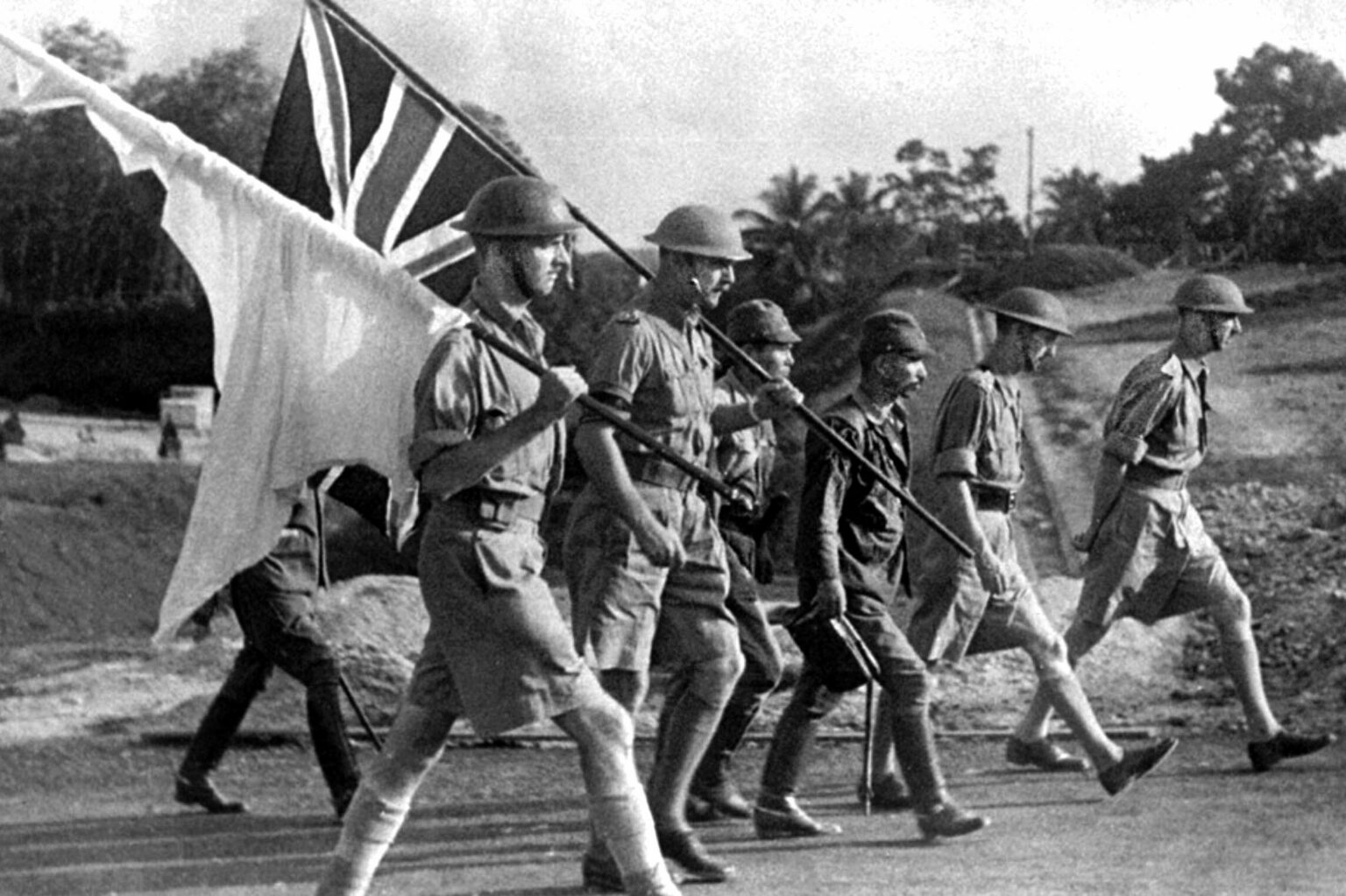
The picture says it all.
It’s an image of defeat.
We see a man dressed in a khaki uniform, with shorts and long socks.
A tin-hat atop his head.
His hands clasped behind his back.
Stooped, dejected, broken.
Marching under a white flag of shame.
That’s what I see in the photo of Lieutenant-General Arthur Ernest Percival, General Commanding Officer Malaya Command, as he walked to the Ford Factory in Singapore on the 15 February 1942 to accept Japanese terms and surrender British-led forces into captivity.
I wonder what was going through his head at the time.
No doubt he was reeling from the shock and surprise and suddenness of the defeat.
Of the many lives lost in the stunning attack from the Japanese Imperial Forces.
Of the hard reality that his surrender would commit 80,000 allied troops into Japanese captivity.
We do know that Percival was concerned about his honour, although his concerns were dismissed by one of his officers who said:
“You need not bother about your honour. You lost that a long time ago…”
Harsh words in a harsh moment.
Percival was robbed by reality, and stung by surrender.
The point is that defeat is always brutal, and defeat is always disorientating.
That’s why the fall of Singapore is such an interesting case study of military failure.
Back in January 2023, I had the opportunity to walk the same ground as General Percival in Singapore.
To see the Ford Factory through my own eyes, and to imagine that momentous surrender in the room where it took place.
But the thing I found more interesting was how the British came to that moment of defeat.
Their lack of imagination.
Their lack of preparedness.
Their lack of perception.
Even as the threat from Japanese forces grew.
That became clear as I explored Fort Siloso, on the southern edge of Singapore.
Why?
Because it taught me that failure to adapt to changing circumstances can be catastrophic.
Before the war, Singapore was believed to be impenetrable.
It was called Fortress Singapore, with coastal guns emplaced around the island to defend against a naval invasion.
Fort Siloso took a place of prominence in those defensive works.
Built in 1874, the Fort sits on Sentosa Island, and commands a dominating view of the southern seaward approach to Singapore.
The guns at Fort Siloso were pointed south, with the blind assumption that any invasion force would come from that direction.
How wrong they were.
As we know, the Japanese invasion of Singapore came from the north—from British-Malaya—rendering Fort Siloso marginal to the struggle that followed.
In vain, the guns of Siloso were turned 180 degrees during the Battle of Singapore, but were fired north only to limited effect.
So, you may ask, why am I talking to you about the battle of Singapore tonight?
In May of this year, we experienced what reporters called “a heavy defeat.”
I’m turning to history because we need to make sense of it.
We need to stare at what we are flinching from: that the failure to adapt to changing circumstances can be catastrophic.
Fort Siloso is a metaphor for the failure to change and adapt to new circumstances.
The Liberal Party, our party, needs to look hard at the failures, as painful as that is for all of us.
Now, change is never easy.
For those of us who identify with the centre-right movement, political change is happening right now across the democratic West.
Whether we like it or not.
And it has consequences for the Liberal Party, and our future electoral success.
Will we retreat into our own Fort Siloso, and hope the battle comes to us?
Or will we adapt to the changing circumstances and fight from a new position of strength?
That is the fundamental question for us all going forward.
Now I want to make clear a few things before I begin my analysis of our present situation.
Two caveats, in fact.
First, I make no criticism of the Opposition Leader or my Parliamentary colleagues.
That is not my intent in this speech, and I ask that you give me the benefit of the doubt where you might perceive an implied jab, barb or kick.
Second, I don’t offer any criticism of the organisational or campaign wing of the Liberal Party.
It’s not my place to do so, and there are reviews underway covering our performance at the recent Federal election.
With that out of the way, let’s begin our journey out of the lank air of the concrete bunkers, and into the open country of political opportunity.
Here’s my roadmap for the next ten mins.
First, I will argue that the world has changed, and our political vision must change with it.
Second, we need to stop talking in abstractions to the Australian people.
Third, we need to position ourselves as the party of common sense, clarity and courage.
First, we cannot live in the past.
We can no longer dine out on the post-Cold war peace dividend, where Francis Fukuyama famously declared the end of history and the total victory of liberalism.
Many expected abstract freedom to sweep the earth, including many in our party. We assumed liberal democracy would simply take root in places where it has never grown before.
But the wars in Afghanistan and Iraq have disproven the folly of that ideology. I saw that first-hand.
So, too, has the economic and political ruptures of the last two decades. The world is vastly different to 2005, but our party has unthinkingly hung on to most of the same beliefs and policies.
Consider the size of the shift:
We’ve seen the Global Financial Crisis followed by the Great Recession.
We’ve seen the rise of Xi Jinping, and a far more assertive Chinese Communist Party in world affairs.
We’ve seen the rise and fall of Islamic State.
We’ve seen the Paris Agreement.
We’ve seen Brexit.
We’ve seen the militarisation of the South China Sea.
We’ve seen the rise of Donald Trump and the MAGA movement.
We’ve seen the rise of woke and identity politics.
We’ve seen the COVID-19 pandemic.
We’ve seen Russia invade Ukraine in 2022.
We’ve seen Hamas attack Israel in 2023.
We’ve seen more than a decade of unconventional monetary policy, with central banks loading up their balance sheets with government and private bonds.
We’ve seen the cheap credit boom as a consequence, and the explosion of housing prices.
We’ve seen the rise of social media and the decline of the mainstream media.
We’ve seen the growth of government across the democratic West.
We’ve seen the rise of populist movements across the political spectrum.
We’ve seen the return of great power competition with the rise of China and India.
We’ve seen energy security take primacy over emissions reduction as the Artificial Intelligence race takes hold.
Everywhere we look, we see change and disruption.
Many of these changes are related, but I’ll leave that to the historians to map and analyse the connective tissue.
But I want to make clear that we are no longer living in the same world of the Howard, Abbott, Turnbull or Morrison years. The world has changed.
The Liberal Party must not take refuge in our established ideas, our fortifications of old beliefs and past glories, and pretend the world remains the same.
Here’s why:
People are growing more cynical by the day about Net Zero, mass migration and the dominance of international institutions in our policymaking.
There seems to be a protest march of some type most weekends from people across the political spectrum.
We shouldn’t be surprised at this.
Energy prices are through the roof. Electricity has risen 24% in the last year alone.
Housing prices keep rising, and many young people feel locked out of their own country.
This is impacting family formation, as our national birth rate has hit an all-time low of 1.5 births per woman.
Meanwhile, immigration has exploded under Labor. The numbers are huge, and we are starting to see our fragile social cohesion break down.
People say they never voted for this, and they feel like they’ve lost control. That’s the overriding feeling that I get when I discuss immigration with the Australian people on the street.
These concerns are derided by some as populist or far-right, but that is to dismiss their legitimate questions on immigration out of hand.
In fact, most so-called populists don’t want to tear down the government.
They just want good government. They want good leadership, and they want a fair go.
They don’t share the libertarian impulse of small government—as if government is the problem and we can all live happily along without it.
Instead, most people want good government that operates within constitutional boundaries and that protects their rights. A limited government focused on the Australian people, that creates the conditions in which they can flourish.
That’s all they want.
To that end, they want the Australian parliament to be sovereign in its decision making, not beholden to climate zealots at the United Nations.
Yet their concerns around Net Zero are dismissed as climate denial, and their concerns around mass migration are dismissed as racist.
The Liberal Party is at a crossroads. The world has changed, and we need to recognise it.
Yes, we can talk about tax and economic reform. They are good areas to focus on. But many people are crying out for a new political vision that places the Australian people at the centre of its orbit.
For that, we can’t ignore their practical questions around what kind of a country we want to be.
Many of these questions are front and centre for regular Australians. They aren’t couched in the language of doctrinaire liberalism, either.
They are simple and concrete questions.
Questions like:
Why can’t we make things here in Australia? Why can’t we have a strong industrial base? Why can’t we have a sovereign manufacturing capability? How can we make Artificial Intelligence work for us?
Why can’t we have affordable housing? Why can’t we have choice on childcare? Why can’t families keep more of their disposable income? How do we make it easier for families to have more children?
Isn’t Australian energy security more important than climate targets? Do we want to depend on China for our energy grid? Why don’t we have our own liquid fuel reserve? Why can’t we refine our own oil? Why can’t we use more of our natural gas to bring our energy costs down?
These are all fundamental questions that we need to ask before we start talking marginal economic and tax reform. Important as those things might be in their proper place. But they are not foundational.
This brings me to my second point.
We must stop talking in abstractions. Most Australians have never read Milton Friedman or Friederick Hayek. Most Australians don’t know the difference between a classical liberal or a Burkean conservative.
Frankly, they don’t care.
Our internal debates on the liberal and conservative traditions within the Liberal Party have found their way into the mainstream. And most Australians, upon reading it, blink at us, and ask: what the hell are you talking about?
That is not to say that our party values are not important. They are vitally important. But we need to talk about them in ways that Australians understand. We sound like ideologues these days, having departed from the commonplace language of Robert Menzies.
Menzies was not an ideological man. A man of conviction, yes. A man of deeply held values, yes. He believed in the individual, family, ordered liberty, the rule of law, reward for effort, in the Crown, in our institutions. But he was no dogmatist. He was pragmatic and was prepared to adapt his means to serve his ends.
I think a recent book, The Forgotten Menzies: The World Picture of Australia’s Longest-serving Prime Minister, is helpful here. As the author’s note, Menzies has been described as conservative, liberal, and even a civic republican. But all those terms are modern-day projections that would have left Menzies scratching his head.
Menzies was not doctrinaire, and his writings on liberalism were largely ‘discursive and superficial’. He did not advocate for an ideological liberalism but instead built a movement that gave expression to the political principles of many Australians who shared his views on the individual, family and aspiration. This was a towering strength for Menzies. And it should be for us.
But our current way of speaking and thinking owes more to neo-liberal intellectuals like Friedrich Hayek, the Austrian-British economist and philosopher.
Somehow, this lifelong academic has shaped the way we talk about government and economics. His seminal work, The Road to Serfdom, published in 1944, still casts a shadow over our thinking.
Hayek’s polemic against Nazism and Stalinism was built on the premise that central planning by government puts us on the pathway to tyranny.
We’ve unconsciously adopted this negative view of government, and its role in the life of the nation.
We instinctively defer to the private sector on questions that are within the realm of government.
Even worse, we base our decisions on the faulty premise that the market always know best. We hesitate to intervene because—according to Hayek—our imperfect knowledge means we’re not equipped to make good decisions.
But isn’t planning what we expect governments to do? To set laws and plan for contingencies? Isn’t that why we elect them to make decisions on our behalf?
And does central planning by government necessarily give rise to tyranny and serfdom?
Obviously, not—if we go by the Australian experience. We’ve managed quite well as a democracy since that book was written during the Second World War. That’s a long time ago.
I think Hayek overcooked his thesis.
In fact, good government prudently plans for the future. That’s exactly why I’m in Parliament—to make plans on behalf of the Australian people so we can thrive in peace, and prevail in war.
That’s why I do this job.
But Hayek still looms large in our thinking. Somehow, we’ve adopted the Hayekian view that we can’t support industry or advanced manufacturing because we don’t have all the required information to make good decisions. I think the rare earths deal this week with President Trump proves otherwise.
Nonetheless, we persist with the belief that only the private sector can make those calls, assuming they have optimal insight and more perfect knowledge of the economy.
We hear this refrain often from free market fundamentalists who are more interested in protecting their own interests, rather than building a strong Australia.
This explains the relentless gaslighting of the public by the Net Zero lobbyists. They are focused on their profits—underwritten by taxpayer subsidies—rather than the national interest.
Never mind the massive cost to Australian families, businesses and industry.
If we think Hayek is right—that the private sector has optimised market knowledge and is best placed to make decisions on these questions—why are we discontent when businesses offshore operations to cheaper jurisdictions in Asia?
We are discontent with such decisions because we know that not everything in life can be reduced to a price signal.
This is where Hayek—for all his book learning—missed a fundamental reality about government.
Governments have a direct interest in cultivating public goods, not simply profit margins. Public goods like a sovereign advanced manufacturing capability.
Good governments are concerned for the strength, security and prosperity of the nation in a way that the private sector is simply not. That’s the reality.
To recover our political fortunes, we must return to the language of Menzies—with his emphasis on the Australian people and common values—and move away from the theoretical language of neo-liberal academics who have shaped our thinking and language for the last thirty years.
On that, my third and final point.
We must be the party of common sense, clarity and courage.
On common sense:
This should be our guide. Most people live by it.
Australians know the biological difference between a man and woman.
They know how to balance the family budget.
Many use their hands for a living.
For them: ‘measure twice, cut once’ is their creed.
They live in the empirical world, not textbooks.
We should lean into this.
We should be able to talk with people from all walks of life.
From security guards to scientists.
From fund managers to tradies.
From schoolteachers to miners.
We have entrepreneurs who know how to create wealth. It comes naturally to them.
They need a government to back them, not more lessons on abstract economics.
For while Friedrich Hayek had to study long and hard to discover that the perfect market doesn't exist, our small business owners live this reality every day.
That’s why they rely on us to level the playing field, to uphold the law and ensure they get a fair go.
To back them against the big guy.
On clarity:
We need a clear political vision of where want to take the country, and we need to be clear about our immediate priorities.
I think they should be energy, immigration, industry, families and education.
If we are not clear, no one will hear what we have to say.
Clarity will make us more distinct in a competitive political marketplace.
Thirdly, on courage:
We must be bold. The moment demands courage.
We are finding our way through great change and uncertainty.
But we have our values to guide us, and all we need now is brave hearts to follow where they take us.
Finally, I know I’ve used a strong image tonight.
But the fall of Singapore was one of the most devastating experiences our nation endured in the Second World War.
I know it’s shocking.
But we need to be shocked. We need to be shaken. We must end our complacency. We have to remove all the blind assumptions that got us here.
Thank you.
Do you like this page?
-
 Peter Jeffrey followed this page 2025-10-31 11:49:49 +0800
 -
Debbie Fitzgibbon followed this page 2025-10-28 06:43:34 +0800
-
Barry Mahony followed this page 2025-10-27 11:31:12 +0800
-
Colin McCallum followed this page 2025-10-27 06:11:29 +0800
-
David Kelsall followed this page 2025-10-26 18:14:11 +0800
-
Jeanette Sims followed this page 2025-10-26 09:04:44 +0800
-
Alan Dray commented 2025-10-26 05:00:54 +0800For me there is no left wing, right wing or political party.
When it comes to election time I seek out commonsense and, (as a logical extension), the sensible centre and vote accordingly.
If more pollies followed Andrew Hastie’s lead I would be spoilt for choice. -
Rochelle Allsop followed this page 2025-10-25 21:27:21 +0800
-
Bryan O’Hara commented 2025-10-25 19:53:01 +0800Andrew – A breath of “Fresh Air” – A very impressive & inspiring talk, I was in attendance & it seems as though the people at the venue were also impressed. Australia needs leadership & your military background offers this – Let’s get back to “Common Sense” i.e. A man is a man & a woman is a woman, here is hoping that your path forward leads you to what Australia needs. Many of the points that you raised need to be addressed & enforced – it appears that you have the qualifications to impliment them – onward & upward, Andrew. (Read the text of his speech – attached) Regards Bryan O’Hara
-
Anthony Byrne followed this page 2025-10-25 17:35:27 +0800
-
Julie Eliott-Lockhart followed this page 2025-10-25 15:13:01 +0800
-
Tom Atkinson commented 2025-10-25 13:34:39 +0800With courage, almost anything is possible. The Libs have almost zero courage at the moment, however.
A lesson of the last two decades is that we must fight the leftist advance EVERY DAY. The Libs never joined the fight on “climate change”. No doubt they thought that was “smart politics”, but it has allowed a whole generation to grow up believing the hoax.
Now the job of fighting that hoax is ten times more difficult. But as we saw for the voice campaign, if you join the fight, you can turn opinion around and win the fight.
All it takes is courage. -
Nanette Black followed this page 2025-10-25 11:13:46 +0800
-
Dorothy Dunshea followed this page 2025-10-25 10:23:50 +0800
-
Karina Doyle followed this page 2025-10-25 10:12:35 +0800
-
Paul Bullen followed this page 2025-10-25 09:07:23 +0800
-
Glenn Skelton followed this page 2025-10-25 09:02:08 +0800
-
Helen Bournon followed this page 2025-10-25 08:48:00 +0800
-
John Wilson followed this page 2025-10-25 08:28:11 +0800
-
Alistair MacPherson commented 2025-10-25 08:27:01 +0800A brilliant speech Andrew . It is so true and so different from the everyday "Gobbledygook"messages that we are subjected to continuously , by obviously vision blind politicians.
-
Alistair MacPherson followed this page 2025-10-25 08:11:48 +0800
-
Terry Hudson followed this page 2025-10-25 07:48:26 +0800
-
Ruth Pringle followed this page 2025-10-25 06:54:09 +0800
-
Karen Elvins followed this page 2025-10-25 06:44:04 +0800
-
Ollie Wauer followed this page 2025-10-25 06:42:07 +0800
-
Alexandra Maxwell followed this page 2025-10-25 06:32:46 +0800
-
Robert W Woodrow followed this page 2025-10-25 06:20:00 +0800
-
Don Clarke followed this page 2025-10-25 05:07:47 +0800
-
Judy Richardson followed this page 2025-10-25 04:48:28 +0800
-
Evie Hyde followed this page 2025-10-24 22:48:16 +0800